CUSTOM SOFTWARE
When nothing off the shelf fits.
We build systems around how your business actually works. It starts with understanding the process, not with choosing a technology.
No cost and no obligation until we agree a scope and a price.
WHO IT IS FOR
Who this is for.
Custom software is the more expensive answer. It is the right answer when the alternative is paying people to be a database.
Your process is the product
How you quote, schedule or reconcile is the thing that makes you money. Bending it to fit a package would cost you the advantage.
You are running on spreadsheets
One file, twelve tabs, three people who know how it works and one who maintains it. It runs the business and nobody can leave.
You have systems that will not go
The accounting package stays. The ERP stays. What you need is the layer that sits between them and the work you actually do.
WHAT YOU GET
What you get.
Every custom engagement produces these, and the first two are yours whether or not you build with us.
- A written scope: what it does, what it does not do, and where the edges are
- A fixed price and a fixed delivery date, agreed before any code is written
- A working demo every week, on a real URL you can open on your phone
- Your data migrated from whatever it is in now, checked row by row
- Integrations with the systems you are keeping, tested against live data
- Training in person, and a written manual for the person who joins next year
- The source code and the database, yours on final payment
- Three months of support included, then a support agreement if you want one
SCOPING
Six questions about the work.
Six questions, about five minutes. You will get an initial response within one business day — from a person who has read your answers.
Loading the scoping form…
HOW IT RUNS
Scope first. Always.
The scoping workshop is chargeable only if you ask us to go deeper than a day. The written scope is yours either way, and you may take it to another developer.
01
Read
A consultant reads your six answers and replies within one business day with what we think the problem actually is.
02
Workshop
Half a day with the people who do the work, not only the people who manage it. We watch the current process end to end.
03
Scope
A written document: features, exclusions, integrations, data migration, a fixed price and a delivery date. You approve or you walk.
04
Build
Two-week cycles with a demo at the end of each. You use the thing while it is being built and change your mind early, not late.
05
Run
Migration outside working hours, training in person, three months of support, then a support agreement if you want one.
WORK SAMPLES
Recent builds.
Real projects, real numbers, across sectors.
Logistics
A regional haulier, 60 vehicles
- Built
- Trip costing and driver settlement, fed by fuel card and GPS data.
Cost per kilometre known weekly instead of quarterly.
Agriculture
A tobacco merchant
- Built
- Grower contracts, input advances and grading, with USD and ZWG on one ledger.
Advance reconciliation went from 9 days to same-day.
Healthcare
A four-site medical group
- Built
- Appointments, claims and a patient portal on top of the existing billing system.
Claim rejections down 34% in the first quarter.
PRICING DETAIL
What actually drives the cost.
We will not put a number on your project from this page, because it would be a guess. These are the five things that move the number, in the order they move it most.
The bands we work in
- Under $5,000
- $5,000 – $15,000
- $15,000 – $50,000
- $50,000+
Most projects land in the middle two bands. If yours is the first band, a product subscription or a website package is probably the better buy, and we will say so on the call rather than after the invoice.
How many integrations
One system to talk to is a week. Four systems, two of them undocumented and one of them a desktop application, is a month.
The state of your data
A clean export is days. Twelve years of spreadsheets with three spellings of every customer name is the single most common overrun.
How many kinds of user
One role is one interface. Six roles with different permissions and approval routes is six interfaces and a permissions model.
Whether the process is agreed
If two managers describe the workflow differently, the first cost is agreeing it. That is a real cost, and it is cheaper before the build.
How fast you need it
Compressing a timeline means more people on the work, and more people on the same work is more expensive per unit delivered.
QUESTIONS
What buyers ask before scoping.
Why will you not give me a price on this page?
Because any number we produced from a form would be wrong, and a wrong number either loses you the project or loses us money on it. The scoping conversation gives you a fixed price you can hold us to.
How long until we see something working?
A demo at the end of every second week from the start of the build. The first one is deliberately rough — it exists so you can tell us early that we have misunderstood something.
What if our requirements change halfway through?
They will. Small changes inside the agreed scope are absorbed. Anything that moves the scope is priced as a written change before we do it, so the number never moves without your signature.
Who owns the code?
You do, on final payment, along with the database and the deployment. We keep no lock. If you want to move to another developer we will hand over documentation and answer their questions.
What technology do you build on?
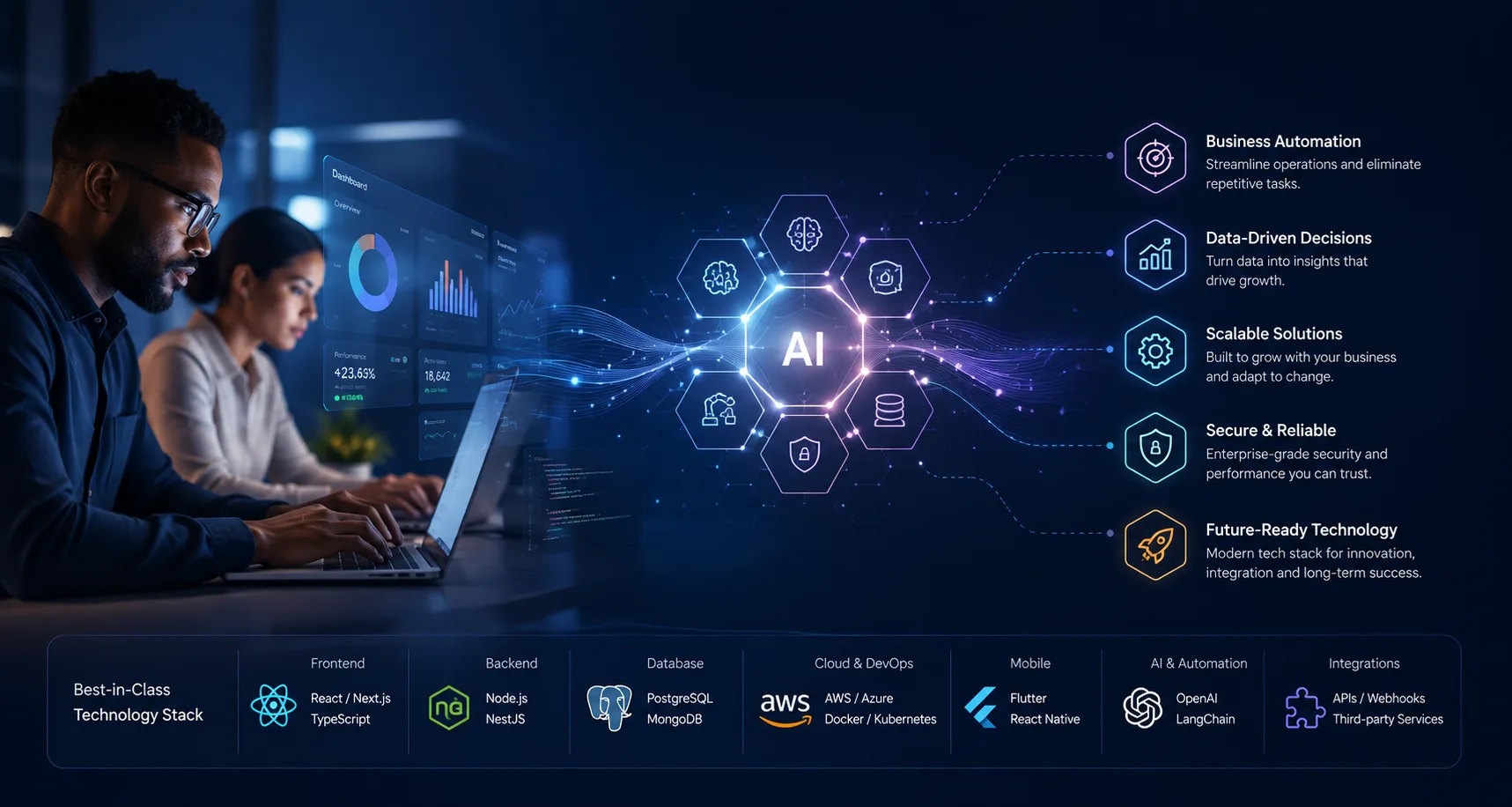
Postgres, TypeScript and a managed host, unless there is a reason not to. We choose it at the scope stage and we tell you why, because the technology is our problem and the outcome is yours.
Where does our data live?
On managed infrastructure with daily backups, and we state the exact region in writing in the scope. Zimbabwe Data Protection Act obligations are covered in the data processing agreement.
Can you take over a system somebody else built?
Often. We start with a paid two-day review that tells you what state it is in and what it would cost to keep. If the honest answer is rebuild, we will say so and show the working.
What happens after go-live?
Three months of support is included. After that, a support agreement with a named contact and agreed response times, or you take it in-house with our documentation. Both are fine.
NEXT STEP
Tell us about the process that is costing you.
Six questions, about five minutes. A consultant reads every answer and replies within one business day.
No obligation, and no cost, until we agree a scope and a price.