AGENTIC AI INTEGRATION
The digital employee you can hire this month, not next year.
We build AI agents that behave like a trained specialist inside the systems you already run — WhatsApp, your ERP, email, your accounting package. They read, decide and act on a defined job continuously, at whatever volume the business throws at them, and hand a person only the case that actually needs one.
Free 20-minute call. We will tell you honestly whether your workflow suits an agent, or whether it just needs a database.
WHY THIS, NOW
The workforce is already changing. This is what it looks like inside a normal business.
Every generation of business technology has automated a layer of work that used to require a person in the room. Spreadsheets automated the ledger clerk. ERPs automated the filing cabinet. Agentic AI automates the layer above that — the person who reads a situation, applies judgement inside clear rules, and acts.
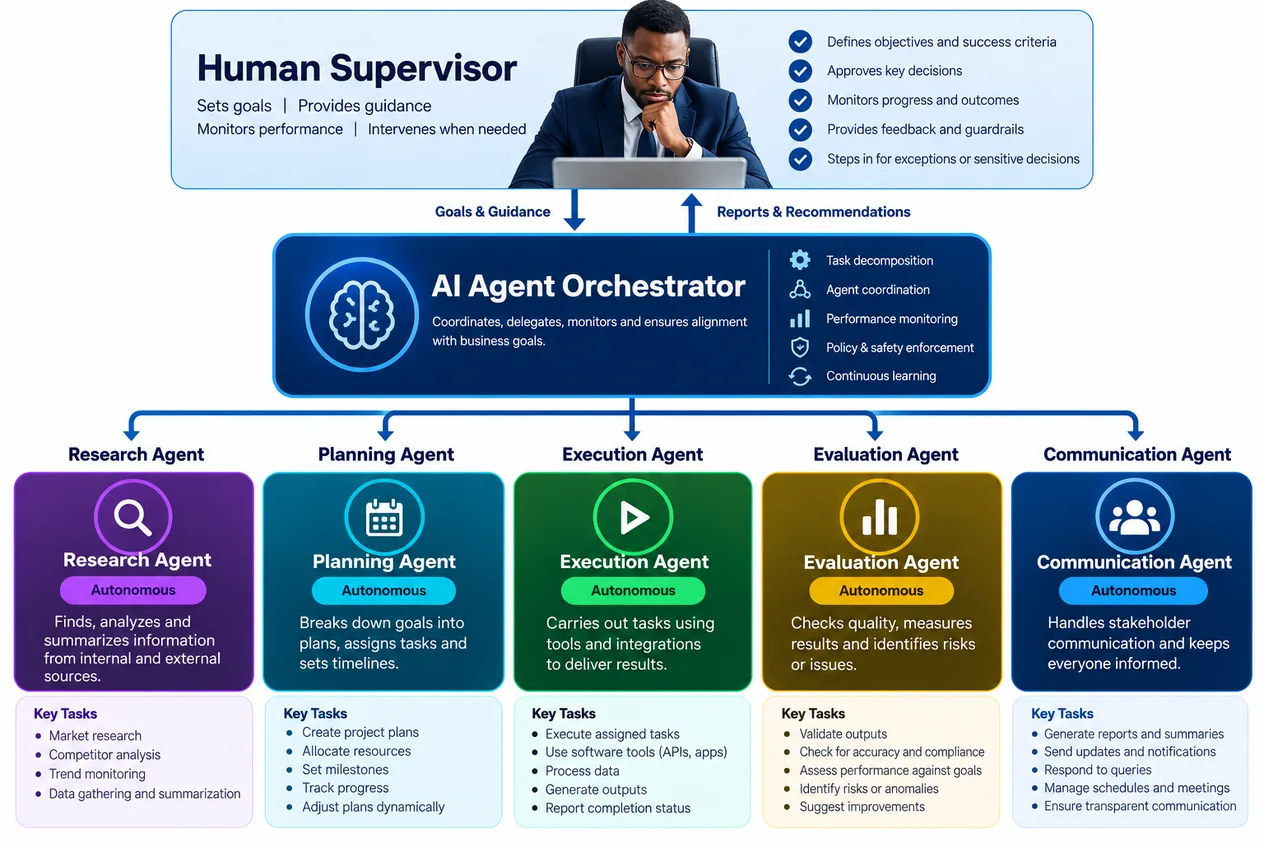
That is not a chatbot bolted onto a website. It is a digital employee: expert in one job, working from the same systems and the same rules your staff already use, supervised the way you would supervise a new hire — with a defined boundary, a visible record of every action, and a person who signs off on anything the rules do not cover.
The businesses adopting this first are not doing it because it is fashionable. They are doing it because the alternative — hiring, training and retaining a person for every repetitive, judgement-light task in the business — has stopped being affordable, and increasingly stopped being possible at all.
WHO IT IS FOR
Every executive already knows this problem.
This is not a pitch for "AI opportunities." These are the reasons a manager is short-staffed today, and the reasons the department around them cannot keep pace with the business.
Headcount is the biggest line on the budget
Every repetitive task you add still means another salary, another desk, another person to train, manage and eventually replace. The cost of doing more work is the cost of doing more hiring.
You cannot hire fast enough to keep up
The role has been open for months. The skill is scarce, expensive, or both. Meanwhile the backlog of enquiries, invoices and applications keeps arriving whether or not the seat is filled.
Your best people do work a junior could do
A qualified person spends half their day reading documents, checking them against a rule, and typing the result somewhere else — instead of the judgement calls only they can make.
Decisions wait for someone to have time
The information to approve, price or escalate something has been sitting there since nine this morning. It is not complicated. It is just waiting in a queue behind everything else that person does.
Customers hear back tomorrow, not today
The enquiry landed at 9pm, on a weekend, or during the one hour everyone was in a meeting. The competitor who replies first usually wins, and reply speed is not something a rota fixes.
Nobody can see the business until month-end
The data exists — in the ERP, the bank feed, the WhatsApp threads — but nobody has the hours to read all of it every day. So problems surface in the management account, three weeks after they started.
DIGITAL EMPLOYEES BY DEPARTMENT
What a digital employee actually does.
Every one of these is a real, working pattern — not a demo. Each agent is scoped to one job, trained on your systems and your rules, and supervised the way a new hire would be, until it has earned the trust to run alone.
Sales & Revenue
The Sales Development Agent
- Qualifies every inbound enquiry the moment it lands, drafts a quote from your real price list, and books the call — at 9pm on a Saturday, not 9am on Monday.
- Chases every unpaid invoice on a schedule, in the right tone for the account, without a person having to remember which ones are overdue.
- Watches stock against sales velocity across every branch and flags what to reorder before a customer hears "out of stock."
Finance & Compliance
The Finance Controller Agent
- Reconciles bank statements against the ledger every day instead of at month-end, and only surfaces the lines that actually do not match.
- Prepares ZIMRA fiscalisation, VAT and PAYE returns from the transactions already in your books, ready for a person to check and file.
- Reads every incoming supplier invoice, checks it against the purchase order and the goods received note, and stops the mismatch before it is paid.
Customer Response
The Customer Response Agent
- Answers the WhatsApp messages that arrive after hours, quoting from your actual price list, and hands over to a person with the conversation already summarised — for the cases that need one.
- Triages every support ticket by urgency and system affected, and resolves the ones that are the same question asked for the hundredth time.
Operations & Supply Chain
The Operations Agent
- Tracks every delivery against its schedule and flags the driver who has gone quiet, before the customer calls to ask where their order is.
- Cross-checks stock counts against the ERP every night and raises the discrepancy before the physical audit finds it.
HR & Administration
The HR Screening Agent
- Screens every application against the role’s actual requirements and ranks them, so a person interviews the top ten instead of reading two hundred CVs.
- Onboards a new starter end to end: issues the checklist, chases the outstanding documents, and sets up the accounts they need on day one.
Executive Intelligence
The Chief of Staff Agent
- Reads every report your systems produce overnight and hands you the one number that changed and why, before your first meeting.
- Watches for the customer who has gone quiet, the supplier whose price moved, and the branch whose numbers do not match last month’s — and tells you before you would have noticed on your own.
WHAT YOU GET
What you get.
One digital employee, one defined job. Not a platform and not a chatbot that might help — a specific role, built, tested, and handed over the way you would hand over any other new hire.
- A written definition of the workflow: what starts it, every step it takes, and where it stops to ask a person
- Access scoped to exactly the systems and records the job needs, and nothing wider
- The agent tested against copies of your real records before it is allowed near live ones
- A stated boundary of what it may decide on its own, and what it must always hand to a person
- A plain-language log of every action it takes, kept long enough to answer a question about any of them
- Monitoring with an alert to a person the moment it stops, or acts outside that boundary
- A way to pause or override it immediately, documented for whoever is on duty
- A shadow period running alongside the person doing the job today, before it is trusted with it alone
SCOPING
Six questions about the workflow.
Six questions, about five minutes. You will get an initial response within one business day — from a person who has read your answers, before the two-day proving stage is ever quoted.
Loading the scoping form…
SUPPORTED SYSTEMS
Where an agent can work.
The systems an agent can already read from and act inside, with what that looks like in practice. Named tools are examples, not the limit — if yours is not listed, ask; the answer is usually yes.
Tax & statutory filings
Prepares the return from the transactions already in your books, in the format your authority expects, and flags the line that needs a person to decide — rather than filing it blind.
- ZIMRA fiscalisation and returns (Zimbabwe)
- VAT, GST and sales-tax returns
- PAYE and payroll submissions
- Your local statutory reporting format
Payments & money movement
Matches every payment to the invoice it belongs to the moment it lands, and chases the ones that have not arrived — on whichever rails your customers actually pay through.
- Mobile money — EcoCash, OneMoney, M-Pesa and equivalents
- Card and online gateways — Paynow, Stripe, PayPal and local acquirers
- Instant transfer rails — ZIPIT, SWIFT, ACH and local equivalents
Banking & ledgers
Reconciles a bank feed against the ledger every day instead of at month-end, and only surfaces the lines that do not match.
- Bank statement feeds, in whatever format your bank exports
- Multi-currency ledgers
- Bulk and batch payment files
Accounting & ERP
Reads and writes directly against the ledger, the stock count or the customer record — the same actions a bookkeeper or clerk would take, at whatever volume the business needs.
- SilverOne ERP
- ASOFT ERP
- Sage, QuickBooks, Xero and Pastel
- NetSuite, SAP Business One and other major ERPs
Messaging, sales & support
Reads an enquiry the moment it arrives, drafts the reply from your real price list or knowledge base, and hands a person only the case that actually needs one.
- WhatsApp Business and other business messaging platforms
- Email and shared inboxes
- Website chat and enquiry forms
- CRM and helpdesk systems
Everything else
If it has a documented way in, an agent can very likely be built against it. This list describes the shape of what is possible, not the limit of it.
- Any documented REST or SOAP API
- Scheduled file exchange — SFTP, CSV, EDI
- Database-level replication
HOW IT RUNS
How an agent gets built.
Short, because most of the risk is not in writing the agent. It is in trusting it with a decision that used to be a person’s.
01
Map
We sit with the person who does the job today. They know where the exceptions are; a workflow diagram does not.
02
Prove
We run the agent against a sample of your real records, without letting it touch anything live, and check every decision it made by hand.
03
Build
The full workflow, with logging, an escalation boundary and monitoring. Priced fixed, because by now we know what the job actually involves.
04
Shadow
The agent runs alongside the person doing the job today. Its decisions are compared to theirs, case by case, until the two agree.
05
Hand over
Monitoring, the pause switch, and the person to call. Then it should be quiet, which is the point.
PRICING DETAIL
How this is priced.
We will not price a workflow before we have watched it, because what it involves on paper and in practice usually differ. What we will fix is the price of finding out.
- Proving stage
- Two days. We map the workflow end to end against real records and show you what the agent got right and wrong on a sample. Fixed price, agreed before we start.
- Fixed, quoted up front
- Build
- Priced from the proving stage, as a fixed number with a delivery date. If the proving stage says the workflow is not safe to automate, you owe nothing further.
- Fixed after proving
- Monitoring and support
- Monthly, per agent, including the alerting and any change to the workflow it runs. Or take it in-house with our documentation.
- Monthly, per agent
One workflow inside one system is usually days of build, after the proving stage. Several workflows, or one that spans systems, is a project. The proving stage is what tells us which one you have.
QUESTIONS
What gets asked on the first call.
How much does an agent cost?
A single workflow inside one system is usually a few days of build, after a two-day proving stage. Several workflows, or one that spans multiple systems, is a project. We price it after we have watched the workflow, not before.
What can it decide on its own, and what does it have to ask about?
That boundary is written down before the agent is built and agreed with you — it is part of the map, not an afterthought. Anything outside it stops and goes to a person, every time.
What happens when it gets something wrong?
It is logged and it is visible. The shadow period exists to catch this before the agent is trusted with the live task, and after go-live, monitoring alerts a person the moment it acts outside its agreed boundary.
Which AI does it run on?
Whichever model suits the task and your data policy. We choose it at the proving stage and tell you why, the same way we choose infrastructure for custom software.
Can it act inside software you did not build?
Yes — that is most of the work. SilverOne ERP and ASOFT ERP are ours; your accounting package, your bank, ZIMRA and the mobile money gateways are not.
Who holds the credentials?
You do. We ask for a service account scoped to exactly what the job needs, document why, and you can revoke it at any time.
What if the workflow changes?
The map changes, not the whole build. A changed step is scoped and priced on its own, agreed with you before it is made.
NEXT STEP
Name the job you cannot hire fast enough for.
Tell us what it is and what it touches. We will tell you on the call whether a digital employee can run it end to end, or only part of it — and we will say so if the honest answer is no.
Free 20-minute call. No obligation.